

Bone Graft & Sinus Lift
A bone graft rebuilds jawbone that is too thin or too soft to support a dental implant. A sinus lift adds bone height in the upper jaw. Both create a stable foundation for implants.
On this page
Overview
A dental implant needs enough healthy jawbone around it to stay stable. When the bone has become too thin or too soft, it may need to be rebuilt first.
A bone graft is a procedure that rebuilds and strengthens jawbone volume when the bone is too thin or too soft to support a dental implant.
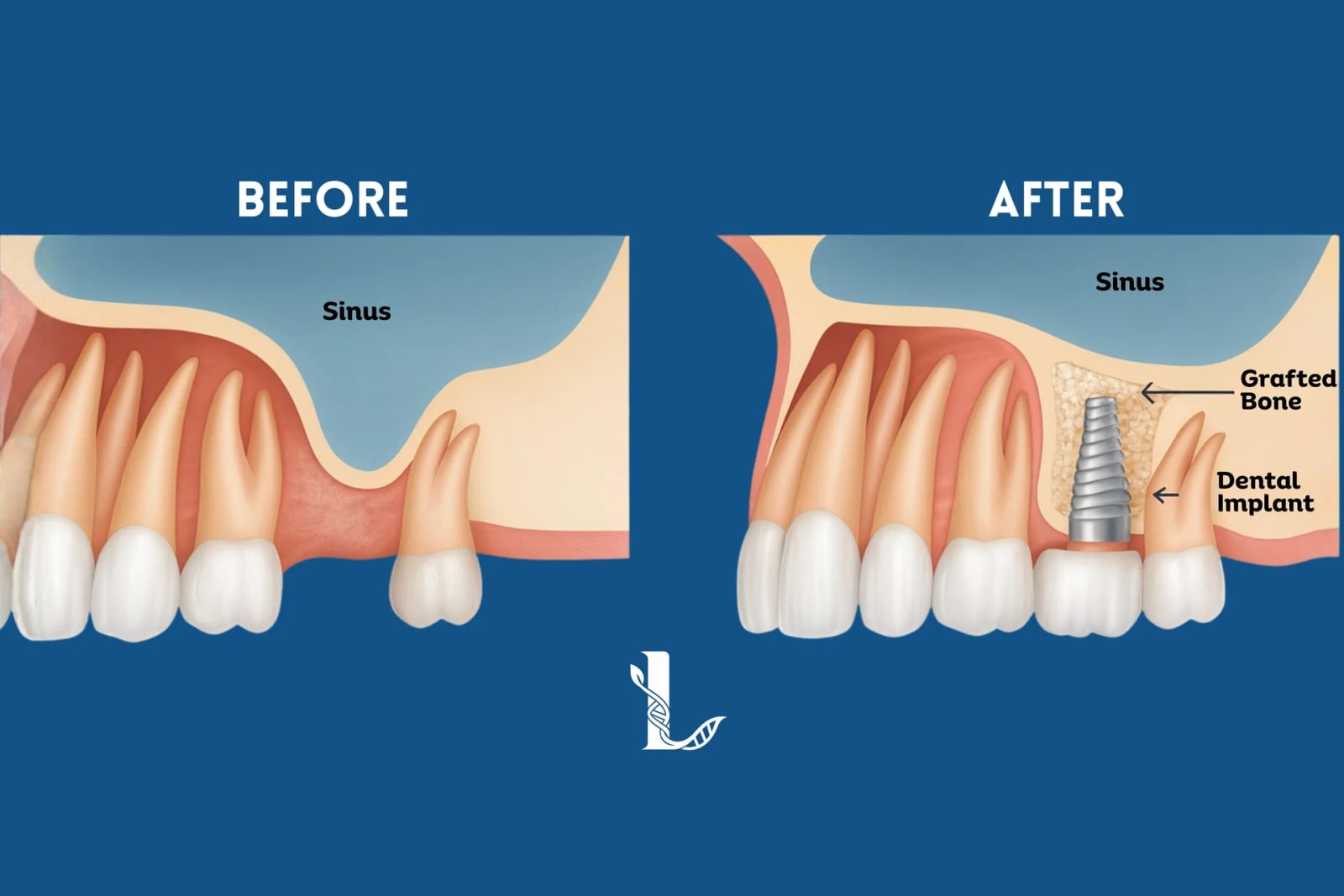
A sinus lift (also called sinus augmentation) is a bone-adding procedure performed in the upper jaw. It increases the bone height beneath the maxillary sinus, the air-filled space above your upper back teeth.
AI-assisted X-ray evaluation by Lumben can help pre-screen your bone height and density before your clinical appointment.
Why you might need a bone graft or sinus lift
A bone graft or sinus lift is often needed after tooth loss, infection or trauma. Common reasons include:
- Bone shrinkage after long-term tooth loss
- Periodontal disease (gum disease)
- Cyst removal or past infections
- Natural anatomical limitations, such as thin bone in the upper jaw
- Bone defects caused by trauma
Who is a good candidate?
You may benefit from a bone graft or sinus lift if you have:
- Not enough jawbone for implants
- Tooth loss in the upper molar or premolar area (the upper back teeth)
- Bone defects caused by gum disease
- A thin sinus floor (the bone between your upper back teeth and the sinus) or naturally low sinus anatomy
The two procedures and graft materials
Bone graft
- Replaces missing or weakened bone tissue
- Helps your natural bone regenerate
- Often necessary after tooth loss, infection or trauma
- Creates a stable foundation for dental implants
Sinus lift
- Used when implants need more vertical bone
- The sinus membrane (the thin lining of the sinus) is gently lifted
- Bone material is placed under the membrane
- Common for implants in the upper molar and premolar area
Graft materials
The bone material can be synthetic, from a donor, bovine-derived (from cattle), or your own bone (an autograft). It is chosen based on your case.
Advantages and risks
Advantages
- Restores jaw strength
- Makes implant placement possible in difficult cases
- Improves long-term implant stability
- Prevents facial collapse caused by bone loss
Risks (generally low)
- Temporary swelling or sinus pressure
- Minor bleeding
- Perforation (a small tear) of the sinus membrane, which is usually repairable
- Infection (rare with proper hygiene)
How the procedures work
Imaging and planning
- Bone graft: a dental X-ray or CBCT scan (a 3D X-ray) measures your bone density, and your treatment is planned around the results.
- Sinus lift: a CBCT scan is used to assess the anatomy of your sinus.
With Lumben, AI-assisted X-ray analysis can support early suitability screening and help estimate your bone height before your clinical appointment.
Preparing the site
- Bone graft: the gum is gently opened, damaged or soft bone is cleaned away, and the area is shaped for the graft.
- Sinus lift: a small window is made in the upper jawbone and the sinus membrane is carefully lifted.
Placing the bone material
- Bone graft: bone substitute (synthetic, donor or your own bone) is packed into the site. A membrane (a thin covering) may be added to protect and stabilise the graft.
- Sinus lift: bone graft material is placed under the lifted membrane, and the space becomes a stable bone region.
Healing
- Bone graft: natural bone grows around the graft over several months, and the graft becomes part of your jawbone.
- Sinus lift: the bone matures over 4–9 months and the sinus membrane adapts naturally.
Implant placement
- Bone graft: once the area has healed, a dental implant can be placed if one is needed. Osseointegration (the implant fusing with the bone) is much more successful with proper graft support.
- Sinus lift: implants are placed after healing, or sometimes during it, giving strong anchorage for long-lasting restorations.
Healing and when to call your dentist
After a bone graft, natural bone grows around the graft over several months. After a sinus lift, the new bone matures over 4–9 months. Implants are placed after healing, or sometimes during it, depending on how stable the bone is and the size of the graft.
When to call your dentist
Contact your dentist if you have:
- Swelling that lasts longer than 1 week
- Fever or unusual discharge
- Sharp sinus pressure or difficulty breathing (after a sinus lift)
- Severe pain that medication doesn’t reduce
- Bleeding that doesn’t stop
Recovery tips
To help your graft heal well:
- Stick to soft foods for a few days
- Avoid blowing your nose (after a sinus lift)
- Don’t smoke: it greatly slows healing
- Keep the area clean as your dentist instructs
- Attend follow-up check-ups so your bone formation can be monitored
What affects the cost of a bone graft or sinus lift?
The cost varies from person to person. The main factors are:
- The type of bone graft material
- The size of the graft area
- Whether a sinus lift is required
- The clinic’s imaging and digital tools
- The expertise of your dentist or surgeon
- Whether the implant is placed at the same time
Frequently Asked Questions
Does a bone graft hurt?
A bone graft is done under local anaesthesia, and discomfort is usually mild.
Is a sinus lift safe?
Sinus lifts are widely performed and considered highly predictable. As with any procedure, there are some risks, such as temporary swelling or sinus pressure, minor bleeding, or a small tear in the sinus membrane, which is usually repairable.
Can implants be placed on the same day?
Sometimes, depending on how stable the bone is and the size of the graft.
What type of bone material is used?
The material can be synthetic, from a donor, bovine-derived (from cattle), or your own bone. It is chosen based on your case.
What happens if I don’t have a bone graft?
Without enough bone support, implants may fail or become impossible to place.
How long does healing take?
After a bone graft, natural bone grows around the graft over several months. After a sinus lift, the bone matures over 4–9 months. Implants are placed after healing, or sometimes during it.
What should I avoid while I heal?
Stick to soft foods for a few days, avoid blowing your nose after a sinus lift, and don’t smoke, as smoking greatly slows healing. Keep the area clean and attend your follow-up check-ups.
AI-Assisted Analysis
Do you have enough bone for an implant?
Upload your X-ray to Lumben for an AI-assisted estimate of your bone height and graft needs, with guidance towards the right clinic.
Analyse my X-ray →